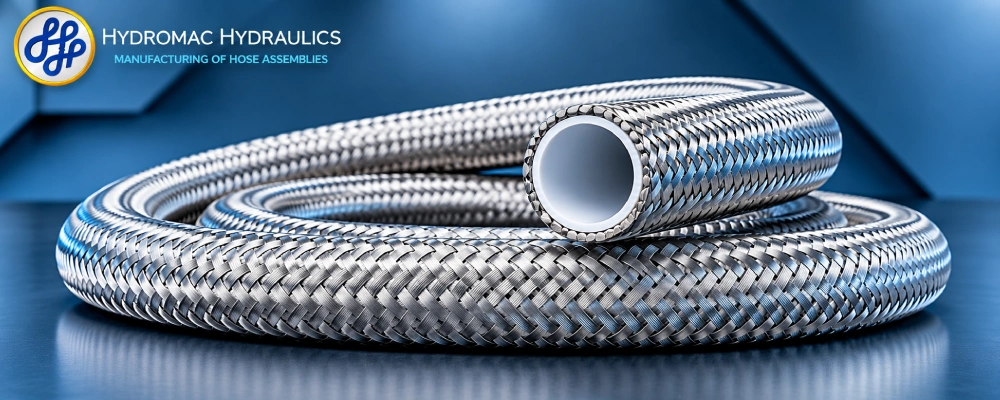
Which Teflon Flexible Hose Is Best for Chemical Transfer Applications?
Selecting the right Teflon flexible hose is essential for safe, reliable, and efficient chemical transfer in industrial environments. Different chemicals can react differently with hose materials, while variations in temperature, pressure, and operating conditions can affect hose performance. Choosing an unsuitable hose may result in leakage, contamination, premature wear, or unexpected maintenance expenses.
A PTFE (Teflon) flexible hose is often a suitable choice for chemical transfer applications because PTFE offers broad chemical resistance, a wide operating temperature capability, and a non-reactive internal surface. However, the best hose depends on the chemical being transferred, its concentration, operating temperature, working pressure, and the type of hose construction required.
Hydromac Hydraulics helps industrial buyers understand hydraulics and industrial hose requirements so they can identify suitable solutions for their applications. For chemical handling operations in Hyderabad and across India, evaluating hose specifications before purchasing can improve equipment reliability and operational safety.
Which Teflon Flexible Hose Is Best for Chemical Transfer Applications?
A PTFE-lined flexible hose with suitable reinforcement is generally a strong option for chemical transfer applications. For general industrial chemical handling, a smooth-bore PTFE hose may be preferred when easy cleaning and efficient flow are important. A convoluted PTFE hose may be more appropriate when greater flexibility and easier routing are required.
The best choice depends on the application's specific requirements rather than the hose material alone.
Consider these important factors before selecting a Teflon flexible hose:
- Chemical compatibility: Confirm that the hose liner, fittings, seals, and other wetted components are compatible with the exact chemical.
- Temperature resistance: Check the manufacturer's rated operating temperature under the actual working conditions.
- Pressure requirements: Select a hose assembly rated for the maximum operating pressure and relevant pressure fluctuations.
- Hose flexibility: Determine whether the installation requires a smooth-bore, convoluted, or specially designed flexible hose.
- Reinforcement material: Choose appropriate stainless-steel braiding or another approved reinforcement based on pressure, temperature, and environmental conditions.
- Connection compatibility: Ensure that end fittings match the piping system and chemical service requirements.
For applications involving aggressive chemicals, high temperatures, or demanding operating conditions, confirm the complete hose assembly specifications with a qualified supplier before installation.
What Is a Teflon Flexible Hose?
A Teflon flexible hose is commonly a flexible hose assembly that uses polytetrafluoroethylene (PTFE) as its internal liner. PTFE is a fluoropolymer known for its chemical resistance, low friction, and ability to perform across a broad temperature range.
The term Teflon is commonly used to refer to PTFE, although Teflon is a trademark associated with specific fluoropolymer products. In industrial hose applications, PTFE-lined assemblies are used to convey compatible liquids, gases, and process materials.
A typical PTFE flexible hose assembly may contain :
- PTFE inner liner: Provides the internal surface that contacts the transferred chemical.
- Reinforcement layer: Stainless-steel wire braiding or another specified material helps the hose withstand pressure.
- Protective outer covering: May be included to improve resistance to abrasion, weather, or external damage.
- End fittings: Connect the hose assembly to pumps, tanks, pipelines, valves, or industrial machinery.
Not every PTFE hose has the same construction. Therefore, buyers should evaluate the complete assembly instead of selecting a hose based only on the word Teflon.
Why Are Teflon Flexible Hoses Used for Chemical Transfer?
PTFE flexible hoses are widely considered for chemical handling because their material properties can address several demanding industrial requirements.
1. Broad Chemical Resistance
PTFE resists many acids, alkalis, solvents, and other industrial chemicals. This makes PTFE-lined hoses useful in applications where conventional rubber or plastic liners may not provide the required compatibility.
However, compatibility is not universal. Certain chemicals, operating conditions, and combinations of temperature and concentration may create additional risks. Always verify compatibility using reliable technical data for the exact chemical.
2. Temperature Performance
PTFE can operate across a broad temperature range compared with many conventional hose liner materials. This makes it a potential choice for chemical processes involving heated fluids or low-temperature service.
The permitted temperature depends on the hose construction, reinforcement, fittings, pressure, and manufacturer specifications. A temperature rating for the PTFE material alone does not establish the safe operating limit of the complete assembly.
3. Low-Friction Internal Surface
A smooth PTFE liner offers a low-friction surface that can support fluid movement and help reduce material adhesion. This can be beneficial when transferring compatible process liquids or when cleaning requirements are important.
Actual flow performance also depends on the hose diameter, length, bends, flow rate, and fluid properties.
4. Flexibility for Industrial Installations
Flexible hose assemblies can accommodate equipment movement, reduce alignment difficulties, and simplify connections between fixed pipelines and machinery.
The appropriate hose design should provide the required flexibility without exceeding its minimum bend radius or creating twisting, kinking, or excessive mechanical stress.
5. Reduced Risk of Product Contamination
PTFE's relatively non-reactive surface makes it useful for applications where maintaining the properties of the transferred material is important.
Nevertheless, contamination control also depends on cleanliness, hose history, fitting materials, cleaning procedures, and the suitability of the entire assembly.
What Types of Teflon Flexible Hoses Are Suitable for Chemical Transfer?
Different PTFE hose constructions serve different operating requirements.
Smooth-Bore PTFE Flexible Hose
A smooth-bore hose has a relatively smooth internal surface.
Best suited for :
- Chemical transfer where flow efficiency is important.
- Applications requiring easier internal cleaning.
- Compatible liquids that benefit from reduced internal surface irregularities.
- Process systems where product residue must be managed carefully.
The required pressure rating, internal diameter, and fitting design must still match the application.
Convoluted PTFE Flexible Hose
A convoluted hose has a corrugated internal structure designed to provide greater flexibility.
Best suited for :
- Installations with restricted routing space.
- Equipment connections requiring increased flexibility.
- Applications where movement and bend requirements influence hose selection.
- Compatible chemical transfer systems requiring a flexible connection.
Convolutions can affect flow characteristics and cleaning requirements. The suitability of a convoluted hose should be assessed against the process's flow, pressure, and sanitation needs.
Stainless-Steel-Braided PTFE Hose
Stainless-steel-braided PTFE hoses combine a PTFE liner with external wire reinforcement. The reinforcement helps the assembly withstand internal pressure within its rated limits.
Best suited for:
- Industrial chemical transfer lines.
- Compatible fluids handled under specified pressure conditions.
- Equipment connections requiring a flexible, reinforced assembly.
- Selected industrial processes involving elevated temperatures within the manufacturer's limits.
The stainless-steel braid is not necessarily the chemical-contacting surface. External exposure, moisture, corrosive atmospheres, and mechanical damage must also be considered when choosing the braid material.
Which Industries Use Teflon Flexible Hoses for Chemical Transfer?
Chemical plants may use PTFE-lined hoses to transfer compatible acids, alkalis, solvents, and process liquids between tanks, pumps, reactors, and pipelines.
Chemical Manufacturing
Chemical plants may use PTFE-lined hoses to transfer compatible acids, alkalis, solvents, and process liquids between tanks, pumps, reactors, and pipelines.
Pharmaceutical Manufacturing
Pharmaceutical facilities may require hoses that meet defined cleanliness and material requirements. The hose assembly must be validated for the specific process, cleaning method, and applicable regulatory expectations.
Food and Beverage Processing
Certain PTFE hose assemblies may be appropriate for food and beverage processing when the complete assembly meets the relevant food-contact requirements. Material suitability, cleanliness, temperature, and certification must be verified.
Paints, Coatings, and Ink Manufacturing
Compatible PTFE-lined hoses can be considered for transferring selected solvents, coatings, and liquid formulations. Chemical compatibility, viscosity, cleaning procedures, and static-control requirements are important considerations.
Petrochemical and Industrial Processing
Some petrochemical operations use PTFE-lined hose assemblies for compatible process fluids. Selection must account for the fluid composition, pressure, temperature, hazardous-area requirements, and applicable industry standards.
How Do You Select the Right Teflon Flexible Hose for Chemical Applications?
Choosing a suitable hose requires a structured evaluation of operating conditions.
Step 1: Identify the Chemical
Record the chemical name, concentration, and relevant composition details. If the process involves a mixture, assess the complete mixture rather than relying on compatibility information for a single ingredient.
Step 2: Check Operating Temperature
Determine the normal temperature, maximum temperature, minimum temperature, and any cleaning or temperature-cycling conditions.
Select an assembly whose documented limits cover the actual operating conditions.
Step 3: Determine Working Pressure
Identify the normal working pressure, maximum expected pressure, pressure surges, and vacuum conditions, if applicable.
Never select a hose based only on its appearance or nominal size. Use the manufacturer's documented pressure ratings and operating restrictions.
Step 4: Choose the Correct Diameter
The hose's internal diameter should support the required flow rate without creating unacceptable pressure losses.
An undersized hose may restrict flow, while an oversized hose may create unnecessary installation costs or fluid-retention concerns.
Step 5: Select Suitable End Fittings
Fittings must be compatible with the chemical, pressure, temperature, and connected equipment. Common connection styles may include threaded, flanged, or other application-specific designs.
The fitting material and sealing components are just as important as the PTFE liner.
Step 6: Evaluate Flexibility and Installation
Check the required bend radius, hose length, movement, routing, and exposure to abrasion or external hazards.
Avoid twisting the hose during installation, exceeding the minimum bend radius, or using the hose to compensate for unsupported piping.
Step 7: Verify the Complete Assembly
Request technical information covering the liner, reinforcement, fittings, pressure and temperature limits, applicable standards, and chemical compatibility.
A qualified supplier should confirm that the complete assembly is appropriate for the intended service.
What Safety Precautions Should Be Followed When Using PTFE Chemical Hoses?
Correct selection must be supported by proper installation, inspection, and maintenance.
- Inspect before use: Look for visible damage, corrosion, deformation, leaks, or deteriorated fittings.
- Follow the specified bend radius: Excessive bending can damage the hose or reinforcement.
- Prevent twisting: Install the assembly without introducing torsional stress.
- Secure connections correctly: Use compatible fittings and the manufacturer's recommended assembly procedures.
- Avoid pressure beyond the rating: Account for operating conditions and pressure surges.
- Inspect regularly: Establish inspection intervals based on chemical exposure, operating severity, and manufacturer guidance.
- Replace damaged assemblies: Do not continue using a hose that shows signs of failure or has exceeded its defined service life.
- Follow safe handling procedures: Depressurize and isolate the system before disconnecting a hose, and follow the relevant chemical safety procedures.
- Consider static electricity: Where flammable liquids or vapours are present, assess electrostatic hazards and use a hose assembly with an appropriate, verified static-control design.
Never assume that every PTFE hose is electrically conductive or suitable for every hazardous chemical environment.
Where Can You Find Teflon Flexible Hoses for Chemical Transfer in Hyderabad?
Industrial buyers searching for Teflon flexible hoses in Hyderabad should compare suppliers based on technical suitability, product documentation, and application support rather than price alone.
Hydromac Hydraulics can be considered when evaluating hydraulics and industrial hose requirements. Buyers should confirm the availability of the required PTFE hose construction, dimensions, fittings, pressure rating, and chemical compatibility before placing an order.
When contacting a supplier, provide the following information :
- Chemical name and concentration.
- Required hose length and internal diameter.
- Normal and maximum operating pressure.
- Minimum and maximum operating temperature.
- Connection type and fitting material.
- Required flexibility and minimum bend radius.
- Applicable industry standards or certification requirements.
- Any cleaning, static-control, or special operating requirements.
Providing these details helps the supplier identify an appropriate hose assembly and reduces the risk of selecting an unsuitable product.
Frequently Asked Questions
1. Which Teflon hose is best for chemical transfer?
A PTFE-lined hose with suitable reinforcement is often a strong choice. Smooth-bore designs may suit applications prioritising flow and cleaning, while convoluted designs may suit installations requiring greater flexibility. The final choice depends on chemical compatibility, pressure, temperature, and connection requirements.
2. Are Teflon flexible hoses resistant to acids?
PTFE resists many acids, making it useful for numerous chemical handling applications. However, resistance depends on the exact acid, concentration, temperature, and hose assembly components. Verify compatibility before use.
3. Can a PTFE hose handle high temperatures?
PTFE can withstand a broad range of temperatures, but the complete hose assembly has specific operating limits. Reinforcement, fittings, pressure, and the manufacturer's specifications determine whether a particular hose is suitable.
4. What is the difference between a PTFE hose and a rubber hose?
PTFE hoses generally offer broader chemical resistance and a wider temperature capability than many conventional rubber hoses. Rubber hoses may offer advantages in certain applications involving flexibility, impact resistance, or specific fluid types. The appropriate material depends on the service conditions.
5. Is a stainless-steel-braided Teflon hose suitable for solvents?
It can be suitable for many solvent-transfer applications when the PTFE liner, fittings, seals, and reinforcement are appropriate for the service conditions. Compatibility and pressure-temperature ratings must be verified for the specific solvent.
6. Can PTFE flexible hoses be used for food-grade applications?
Some PTFE hose assemblies are suitable for food-contact applications when the complete assembly meets the relevant requirements. Confirm the applicable certifications, fitting materials, cleaning compatibility, and operating conditions.
7. How long does a Teflon flexible hose last?
Service life varies with pressure, temperature, chemical exposure, movement, installation quality, and maintenance. Follow the manufacturer's inspection and replacement guidance rather than relying on a universal lifespan.
8. How do I choose the correct PTFE hose size?
Select the internal diameter based on the required flow rate, fluid properties, hose length, and acceptable pressure drop. Also confirm the end connections, pressure rating, and installation space.
9. Are PTFE hoses suitable for high-pressure chemical transfer?
Certain reinforced PTFE hose assemblies are designed for specified high-pressure applications. Their suitability depends on the manufacturer's rated working pressure, temperature, fittings, and operating conditions. Never infer pressure capability from the liner material alone.
10. Where can I find a Teflon flexible hose supplier in Hyderabad?
Industrial buyers can contact Hydromac Hydraulics to discuss their hose requirements and confirm the availability of a suitable solution. Share the chemical details, operating conditions, dimensions, and fitting requirements to support accurate product selection.
