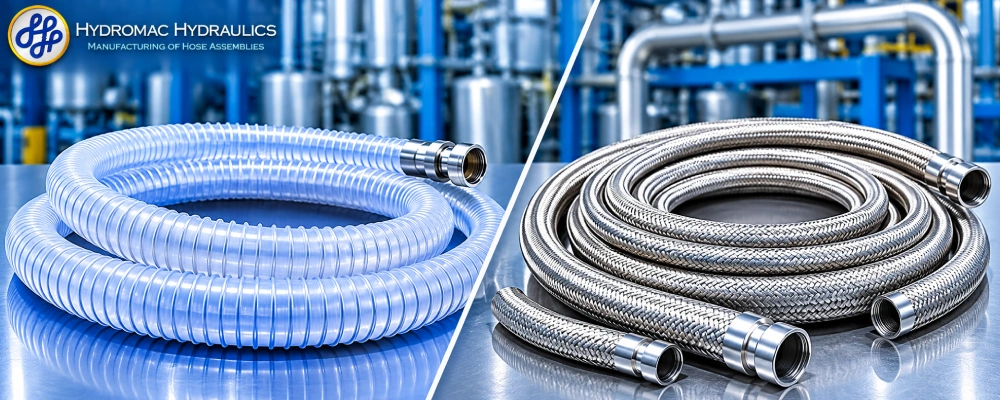
How Do PTFE and Stainless Steel Flexible Hoses Differ in Industrial Use?
Flexible hoses play an important role in industrial fluid transfer systems, helping transport liquids, gases, chemicals, steam, and hydraulic fluids between connected equipment. Selecting the right hose is essential for maintaining operational efficiency, preventing leaks, and ensuring safe working conditions. Two commonly considered options are PTFE flexible hoses and stainless steel flexible hoses. Although both are used in demanding industrial environments, they differ in material composition, chemical resistance, temperature capabilities, pressure handling, flexibility, and application suitability.
Understanding how PTFE and stainless steel flexible hoses differ can help businesses choose the right solution for their operating conditions. Factors such as the type of fluid, operating pressure, temperature range, movement, and installation environment should be considered before making a selection.
Hydromac Hydraulics helps industrial businesses understand hydraulic and fluid-handling requirements so they can make informed decisions about suitable hose solutions for their equipment and processes.
What Are PTFE Flexible Hoses?
PTFE (polytetrafluoroethylene) flexible hoses use a fluoropolymer inner tube known for its broad chemical resistance, low friction, and non-stick properties. Depending on the design, the PTFE tube may be smooth-bore or convoluted to provide different flow and flexibility characteristics. Stainless steel wire braiding or another suitable reinforcement may be added to improve pressure-handling capability.
PTFE hoses are widely considered for applications where the conveyed medium may be chemically aggressive, difficult to handle, or sensitive to contamination.
Key Features of PTFE Flexible Hoses :
- Chemical resistance: PTFE is compatible with many acids, solvents, oils, and industrial chemicals, although compatibility must be verified for the exact fluid and operating conditions.
- Low friction: Its smooth inner surface can support efficient fluid flow and reduce material adhesion.
- Temperature capability: PTFE can operate across a broad temperature range, but the complete hose assembly has specific temperature limits.
- Reduced contamination risk: Its non-stick characteristics make it useful in applications where residue buildup must be minimized.
- Reinforcement options: Stainless steel braiding and appropriate end fittings can improve mechanical strength and pressure performance.
PTFE hoses are often considered in chemical processing, pharmaceutical manufacturing, food and beverage processing, and specialised industrial fluid-transfer systems.
What Are Stainless Steel Flexible Hoses?
Stainless steel flexible hoses are commonly manufactured from corrugated stainless steel tubing, sometimes with an external stainless steel braid. The corrugated structure allows the hose to bend and accommodate movement, while the metal construction provides strength and resistance to many demanding environmental conditions.
These hoses are used in applications that require metal fluid containment, resistance to external damage, or the ability to accommodate thermal expansion, vibration, and equipment movement. Their suitability depends on the stainless steel grade, corrugation design, reinforcement, fittings, and operating conditions.
Key Features of Stainless Steel Flexible Hoses :
- Metal construction: The stainless steel tube provides a durable barrier for compatible fluids and gases.
- Pressure support: Corrugation, braid, diameter, and assembly design influence the pressure rating.
- Temperature resistance: Stainless steel can perform in high-temperature environments, subject to the limits of the complete assembly.
- Mechanical durability: Appropriate designs can accommodate vibration, movement, and thermal expansion.
- Environmental resistance: Suitable stainless steel grades can resist corrosion in many industrial environments, but not all chemicals or conditions.
Stainless steel flexible hoses are commonly considered for industrial gas lines, hot-fluid transfer, steam-related systems, process equipment, and applications involving vibration or movement.
How Do PTFE and Stainless Steel Flexible Hoses Differ?
The primary difference is the material forming the hose's fluid-contacting inner wall. A PTFE hose uses a fluoropolymer liner, while a conventional stainless steel flexible hose uses corrugated metal tubing. This difference affects chemical compatibility, cleanliness, flexibility, mechanical behaviour, and application suitability.
Comparison Between PTFE Flexible Hose and Stainless Steel Flexible Hose
- Inner Material:
- PTFE Flexible Hose: Made from PTFE fluoropolymer.
- Stainless Steel Flexible Hose: Made from stainless steel metal.
- Chemical Resistance:
- PTFE Flexible Hose: Offers excellent resistance to many chemicals; fluid compatibility should be verified.
- Stainless Steel Flexible Hose: Resistance depends on the stainless steel grade and chemical environment.
Temperature Suitability:
- PTFE Flexible Hose: Supports a broad temperature range, depending on the complete hose assembly.
- Stainless Steel Flexible Hose: Often suitable for high-temperature applications within specified design limits.
Flexibility:
- PTFE Flexible Hose: Flexibility depends on whether the hose has a smooth-bore or convoluted design.
- Stainless Steel Flexible Hose: Corrugation allows bending and movement.
Pressure Capacity:
- PTFE Flexible Hose: Depends on the liner, braid, fittings, hose size, and operating temperature.
- Stainless Steel Flexible Hose: Depends on corrugation, braid, size, fittings, and operating temperature.
Cleanliness:
- PTFE Flexible Hose: Its low-adhesion surface can help reduce residue retention.
- Stainless Steel Flexible Hose: Its metal construction may suit applications requiring metal containment.
Common Applications:
- PTFE Flexible Hose: Used for chemical transfer, solvents, and specialised fluid-handling applications.
- Stainless Steel Flexible Hose: Used for steam, hot fluids, gases, vibration control, and industrial process lines.
Main Selection Concern:
- PTFE Flexible Hose: Check fluid compatibility and complete assembly limitations.
- Stainless Steel Flexible Hose: Consider corrosion resistance, fatigue, and bending limitations.
Which Hose Offers Better Chemical Resistance: PTFE or Stainless Steel?
PTFE flexible hoses are often preferred when handling aggressive chemicals because PTFE resists a broad range of chemical substances. This can make it suitable for transferring certain acids, solvents, and specialised process fluids that may attack some metals.
Stainless steel hoses can also provide excellent chemical resistance when the correct grade is selected. However, their performance may vary significantly depending on the chemical concentration, temperature, exposure duration, and presence of chlorides or other corrosive substances.
Before selecting a hose, businesses should :
- Identify the exact chemical and its concentration.
- Check the manufacturer's chemical compatibility information.
- Consider operating temperature and pressure together.
- Confirm the suitability of the hose reinforcement and end fittings.
- Evaluate the consequences of leakage, contamination, or material degradation.
Practical takeaway: PTFE is frequently a strong candidate for chemically aggressive fluid transfer, while stainless steel may be appropriate where the fluid is compatible with the selected alloy and the system requires metal tubing.
Which Is Better for High-Temperature Industrial Applications?
Stainless steel flexible hoses are often considered for high-temperature duties, including certain steam and hot-fluid systems. Metal tubing can tolerate demanding thermal conditions, provided the hose assembly, braid, fittings, and connected equipment are rated for the service.
PTFE also has useful high- and low-temperature capabilities. However, its allowable operating pressure can decrease as temperature increases, and the limits of the reinforcement and end connections must also be considered.
When choosing a hose for elevated temperatures, check:
- Maximum and minimum operating temperatures.
- Pressure ratings at the actual service temperature.
- Temperature cycling and thermal expansion.
- Compatibility with the conveyed medium.
- The temperature limitations of seals, fittings, and external components.
For steam and other high-energy services, use a hose assembly specifically designed and rated for the intended application. Never assume that a hose is suitable solely because its base material can tolerate a particular temperature.
How Do PTFE and Stainless Steel Hoses Differ in Flexibility?
Flexibility depends on the hose construction rather than just the material name. A convoluted PTFE hose can offer greater bending flexibility than a smooth-bore PTFE design, while a corrugated stainless steel hose accommodates movement through its formed metal profile.
PTFE hoses may be useful where routing, chemical compatibility, or reduced internal adhesion is important. Stainless steel hoses may be advantageous where the installation must accommodate vibration, thermal movement, or changing equipment positions.
To protect either type of hose :
- Follow the manufacturer's minimum bend radius.
- Avoid twisting during installation.
- Prevent repeated bending at the same location unless the design permits it.
- Support the hose appropriately and avoid unnecessary mechanical loads.
- Select the correct length to accommodate movement without excessive strain.
Correct installation is essential because excessive bending, twisting, and vibration can shorten service life even when the hose material is suitable.
Where Are PTFE and Stainless Steel Flexible Hoses Used?
Both hose types serve a range of industrial sectors, but their applications often differ according to fluid compatibility and operating conditions.
Common Applications of PTFE Flexible Hoses :
- Chemical manufacturing and transfer systems.
- Pharmaceutical and speciality process equipment.
- Food and beverage processing, where the complete assembly meets applicable hygiene requirements.
- Solvent and oil transfer systems.
- Industrial equipment requiring low-adhesion fluid-contact surfaces.
- Applications involving specialised or chemically aggressive media.
Common Applications of Stainless Steel Flexible Hoses :
- Certain steam and hot-fluid systems.
- Industrial gas transfer.
- Process piping connections.
- Equipment exposed to vibration or thermal expansion.
- Manufacturing plants and industrial machinery.
- Applications requiring compatible metal tubing and external mechanical protection.
The final choice should always be confirmed against the equipment manufacturer's specifications, relevant safety requirements, and actual service conditions.
Which Hose Is Better for Hydraulic Systems?
Hydraulic systems commonly use hoses specifically designed to carry hydraulic oil at the required working pressure and withstand pressure surges, movement, and environmental exposure. PTFE and stainless steel flexible hose assemblies can be suitable for selected hydraulic or industrial fluid applications, but neither should be treated as a universal replacement for a purpose-designed hydraulic hose.
For hydraulic service, evaluate :
- Normal working pressure and pressure spikes.
- Hydraulic fluid compatibility.
- Oil temperature and ambient temperature.
- Required movement and bend radius.
- End fittings and connection standards.
- Abrasion, vibration, and external exposure.
- Applicable industry specifications and safety requirements.
A correctly specified hydraulic hose assembly helps support reliable fluid transfer and reduces the risk of leaks or premature failure. Businesses should consult a qualified supplier or engineer when the operating requirements are uncertain.
How Do You Choose the Right Flexible Hose for Your Industry?
Selecting a hose involves more than comparing the purchase price or material. The complete assembly must match the fluid, pressure, temperature, installation, and maintenance requirements.
Use the following checklist :
- Identify the fluid: Confirm its composition, concentration, viscosity, and compatibility with the hose's wetted materials.
- Determine pressure requirements: Consider working pressure, pressure surges, and the manufacturer's temperature-adjusted ratings.
- Confirm temperature limits: Check both the fluid temperature and the surrounding environment.
- Assess movement: Determine whether the hose must accommodate vibration, equipment movement, or thermal expansion.
- Check fitting compatibility: Ensure the end connections, seals, and materials suit the system.
- Review installation conditions: Account for bend radius, routing, abrasion, and external exposure.
- Consider maintenance: Establish inspection intervals and replacement criteria based on the application and manufacturer guidance.
- Verify compliance: Check relevant industry standards, pressure requirements, and any applicable hygiene or process-safety requirements.
A systematic selection process helps businesses avoid incompatible materials, incorrect pressure ratings, and preventable installation problems.
Why Should Industrial Businesses Consult Hydromac Hydraulics?
Choosing between PTFE and stainless steel flexible hoses requires a clear understanding of the application and the performance limits of the complete hose assembly. Industrial buyers need to consider reliability, compatibility, operating conditions, and long-term maintenance before finalising a specification.
Hydromac Hydraulics can be approached for guidance on hydraulic and industrial hose requirements, product suitability, and application-related considerations. When requesting assistance, businesses should provide the fluid type, working pressure, temperature range, hose dimensions, connection details, and operating environment.
For industrial operations in Hyderabad and surrounding manufacturing areas, working with a knowledgeable hydraulic supplier can help streamline product selection and support more informed purchasing decisions. Confirm the availability and suitability of specific hose products directly with Hydromac Hydraulic.
Frequently Asked Questions (FAQs)
1. What is the main difference between PTFE and stainless steel flexible hoses?
PTFE hoses have a fluoropolymer inner tube that provides broad chemical resistance and low-adhesion characteristics. Stainless steel flexible hoses typically use corrugated metal tubing and are often considered for compatible hot-fluid, gas, vibration, and thermal-movement applications.
2. Is a PTFE hose better than a stainless steel hose for chemicals?
PTFE is often suitable for aggressive chemicals because it resists many corrosive substances. However, compatibility must be checked for the exact chemical, concentration, temperature, fittings, and hose construction. Stainless steel may also be suitable when the correct alloy is selected.
3. Can PTFE flexible hoses handle high temperatures?
Yes, some PTFE hose assemblies are designed for elevated temperatures. Their maximum working pressure and temperature limits depend on the complete assembly, including reinforcement and fittings. Always consult the manufacturer's ratings.
4. Are stainless steel flexible hoses suitable for steam?
Certain stainless steel hose assemblies are designed for steam applications. The assembly must be specifically rated for the steam temperature, pressure, movement, and intended service. An ordinary metal hose should not automatically be assumed suitable for steam.
5. Which flexible hose is best for hydraulic oil?
The best option depends on the hydraulic oil, operating pressure, temperature, pressure surges, movement, and fitting requirements. Use a hose assembly specifically rated for the intended hydraulic service rather than choosing based on material alone.
6. Do PTFE hoses contain stainless steel?
Some PTFE flexible hoses use stainless steel wire braiding as external reinforcement. However, construction varies by model. Buyers should verify the liner, reinforcement, fittings, and pressure rating before ordering.
7. How do I choose an industrial flexible hose supplier in Hyderabad?
Look for a supplier that can help evaluate fluid compatibility, pressure and temperature requirements, hose dimensions, fitting standards, and application conditions. Industrial buyers in Hyderabad can contact Hydromac Hydraulic to discuss their requirements and confirm suitable product options.
8. What information is required to select a flexible hose?
Provide the fluid name, working pressure, temperature range, hose diameter and length, connection type, installation space, movement requirements, and operating environment. This information helps a supplier or engineer assess suitable hose assemblies.
9. Do PTFE and stainless steel hoses require regular inspection?
Yes. Inspection frequency depends on the application, operating severity, manufacturer guidance, and relevant safety requirements. Check for leakage, abrasion, corrosion, deformation, fitting damage, and signs of fatigue. Replace damaged assemblies according to approved maintenance procedures.
10. Can PTFE and stainless steel hoses be used interchangeably?
No, not without a technical assessment. Their materials, pressure-temperature behaviour, flexibility, chemical compatibility, and mechanical characteristics differ. Any replacement should be approved for the actual operating conditions and connection requirements.
