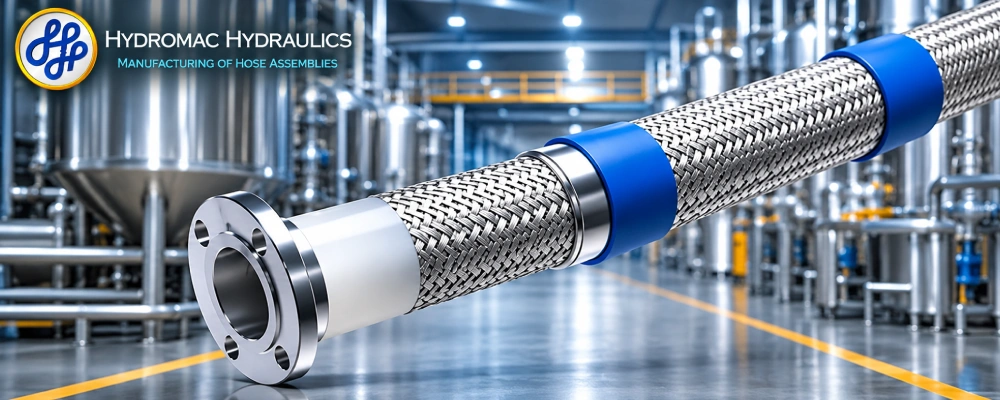
How to Choose the Right PTFE Flexible Hose for Industrial Applications?
Choosing the right PTFE flexible hose is an important decision for industries that handle chemicals, high-temperature fluids, compressed gases, hydraulic media, and other demanding materials. The correct hose helps maintain fluid transfer efficiency, reduces the risk of leakage, supports equipment performance, and improves operational safety. However, selecting a suitable hose requires more than checking its size or pressure rating. Factors such as temperature, chemical compatibility, operating pressure, hose construction, flexibility, and end connections must also be considered.
For industries operating in Hyderabad and across India, selecting the right industrial hose can help reduce maintenance interruptions and support consistent production. Hydromac Hydraulic helps industrial buyers understand hydraulic and fluid-transfer requirements so they can make informed equipment decisions.
This guide explains how to choose the right PTFE flexible hose for industrial applications, which specifications matter most, and what businesses should consider before purchasing a hose for their operating environment.
What Is a PTFE Flexible Hose?
A PTFE flexible hose is a fluid-transfer component manufactured using polytetrafluoroethylene (PTFE), a synthetic fluoropolymer known for its chemical resistance, low friction, and ability to withstand a broad range of temperatures. Depending on the design, the hose may feature a smooth or convoluted PTFE inner tube, with stainless steel wire braiding or other reinforcement to provide mechanical strength and pressure resistance.
PTFE hoses are commonly used where conventional rubber hoses may not provide the required chemical compatibility, temperature performance, or fluid cleanliness.
Key characteristics of PTFE flexible hoses include :
- Chemical resistance: Suitable PTFE grades can handle many aggressive chemicals, subject to compatibility with the fluid, temperature, concentration, and operating conditions.
- Temperature resistance: PTFE materials can operate across a wide temperature range, although the complete hose assembly may have more restrictive limits.
- Low friction: The smooth inner surface of many PTFE hoses supports fluid movement and helps reduce material buildup.
- Flexibility: Depending on its construction, a PTFE hose can accommodate equipment movement and routing requirements.
- Clean fluid transfer: PTFE can be appropriate for applications that require low contamination risk, provided the complete assembly meets the necessary cleanliness standards.
- Corrosion resistance: The PTFE liner offers resistance to many corrosive substances, while the reinforcement and fittings must also suit the application.
How to Choose the Right PTFE Flexible Hose for Industrial Applications?
The right PTFE flexible hose should be selected by matching the hose assembly to the actual operating conditions. Before placing an order, evaluate the following factors.
1. Check Chemical Compatibility
Chemical compatibility should be one of the first considerations when selecting an industrial PTFE hose. Although PTFE resists many chemicals, the complete assembly must be suitable for the specific substance being transferred.
Review the following details :
- Type of chemical or fluid.
- Chemical concentration and purity.
- Operating and cleaning temperatures.
- Exposure duration and frequency.
- Compatibility of the liner, reinforcement, fittings, seals, and connection materials.
For example, a chemical processing plant transferring corrosive liquids may require a PTFE-lined hose. However, selecting a compatible liner alone is not enough if the metal braid or end fittings are exposed to a corrosive environment.
Selection tip: Provide the hose supplier with the fluid's name, concentration, and operating temperature. Request confirmation of compatibility for the complete hose assembly rather than relying only on the properties of PTFE.
2. Determine the Operating Temperature
Temperature directly affects hose performance, flexibility, pressure capacity, and service life. PTFE is known for its broad temperature tolerance, but the allowable range varies by hose construction and manufacturer specifications.
Consider both the highest and lowest temperatures the hose will experience.
- High-temperature applications: Industrial ovens, heated fluid transfer, chemical processing, and certain manufacturing systems may require a hose designed for elevated temperatures.
- Low-temperature applications: Refrigeration, cold-fluid transfer, and outdoor installations may require a hose that remains suitable under low-temperature conditions.
- Temperature fluctuations: Systems that alternate between hot and cold operating cycles need a hose assembly designed for repeated thermal changes.
- Cleaning cycles: Steam, hot flushing, or chemical cleaning may impose additional requirements beyond normal operating temperatures.
Always check the rated temperature range of the complete hose assembly, including fittings and seals. The maximum temperature rating should not be treated as an automatic guarantee of maximum pressure capacity at that temperature.
3. Understand Working Pressure and Pressure Spikes
Pressure rating is a critical factor in hydraulic and industrial fluid-transfer systems. The selected hose must safely handle the normal working pressure as well as foreseeable pressure fluctuations.
Before choosing a hose, identify :
- Normal operating pressure.
- Maximum system pressure.
- Pressure surges and pulsation.
- Pump or compressor operating characteristics.
- Temperature-related pressure derating.
- Applicable safety factors and manufacturer recommendations.
A hose that appears suitable under normal conditions may be unsuitable if the system regularly experiences sudden pressure spikes.
For hydraulic applications, verify that the hose assembly is specifically rated for the intended service. PTFE construction does not automatically make a hose suitable for every high-pressure hydraulic system.
Important: Never select a hose based solely on its material or advertised maximum pressure. Confirm the working-pressure rating for the exact diameter, construction, temperature, and fitting configuration.
4. Select the Correct Hose Diameter
The internal diameter of a PTFE flexible hose affects fluid velocity, pressure drop, flow capacity, and overall system performance.
An undersized hose may restrict flow and increase pressure losses. An oversized hose may increase cost, occupy more installation space, and affect system response in certain applications.
Consider these factors when choosing the diameter :
- Required flow rate.
- Fluid viscosity and density.
- Permitted pressure drop.
- Hose length and routing.
- Pump or equipment specifications.
- Required response time in hydraulic systems.
For example, a manufacturing line that transfers a high volume of liquid may require a larger internal diameter than a small dosing system. The final size should be determined through flow calculations and the equipment manufacturer's recommendations.
5. Choose the Right PTFE Hose Construction
PTFE flexible hoses are available in different constructions to suit specific operating conditions. Understanding the differences helps prevent the selection of an unsuitable product.
Smooth-bore PTFE hose: This design has a relatively smooth internal surface, making it useful where cleanability, reduced flow resistance, and low material retention are important.
Convoluted PTFE hose: Its corrugated inner tube provides greater flexibility in many configurations. It can be useful where installation space is restricted or the hose must follow a curved path.
Stainless steel braided PTFE hose: Metallic braiding reinforces the hose and helps it withstand pressure. The required braid configuration depends on the application and the manufacturer's specifications.
Specialized PTFE hose assemblies: Certain applications may require additional protection, special covers, specific fitting materials, or other design features to meet environmental and operational requirements.
When comparing these options, assess pressure requirements, bend radius, cleaning needs, fluid characteristics, and the movement expected during operation.
6. Check the Minimum Bend Radius
Bend radius describes how tightly a hose can be curved without compromising its performance. Every hose design has a specified minimum bend radius.
Bending a hose more tightly than permitted can create excessive stress, distort the inner tube, damage reinforcement, or reduce service life.
To select a suitable hose :
- Measure the available installation space.
- Identify the required routing path.
- Check the manufacturer's minimum bend radius.
- Allow sufficient room around fittings and equipment.
- Avoid twisting the hose during installation.
- Use suitable supports where necessary.
For machinery with moving components, account for the hose's entire movement path rather than checking only its stationary position.
7. Choose Compatible End Connections and Fittings
End connections determine how the hose attaches to machinery, pipelines, valves, pumps, and other equipment. Incorrect fittings can cause leakage, connection failure, and unnecessary maintenance.
Common connection options may include threaded fittings, flanges, and other application-specific connectors.
Before ordering, confirm :
- Connection type and thread standard.
- Nominal size and dimensions.
- Pressure and temperature ratings.
- Fitting material and corrosion resistance.
- Seal type and compatibility.
- Installation orientation and available clearance.
Do not assume that two fittings are interchangeable simply because they have similar dimensions. Thread profiles, sealing methods, and pressure capabilities may differ.
For demanding applications, procure the hose and fittings as a compatible assembly from a qualified supplier.
8. Evaluate Environmental and Installation Conditions
The operating environment also affects hose selection. A hose installed inside a protected production area may face different challenges from one exposed to outdoor weather, abrasive surfaces, vibration, or corrosive vapours.
Evaluate whether the installation involves :
- External heat or cold.
- Mechanical abrasion.
- Vibration or repetitive movement.
- Exposure to moisture or corrosive atmospheres.
- Tight routing or restricted access.
- Potential contact with sharp edges.
- Static electricity or electrical bonding requirements.
Where the application involves combustible vapours, flammable fluids, or sensitive process materials, consult the relevant safety requirements and the manufacturer's guidance for electrical continuity, grounding, and static control.
Which Industries Use PTFE Flexible Hoses?
PTFE flexible hoses are used across several industries because their material properties can suit demanding fluid-transfer requirements. The exact hose design depends on the process and operating conditions.
Chemical and Pharmaceutical Industries
Chemical plants may use PTFE hoses for transferring compatible acids, solvents, and process chemicals. Pharmaceutical facilities may use appropriately specified assemblies where cleanability and material compatibility are important.
The hose assembly should meet the applicable process, hygiene, and regulatory requirements.
Food and Beverage Processing
Certain food and beverage operations use specially designed PTFE hose assemblies for transferring compatible ingredients and process fluids. Food-contact compliance must be verified for the specific product and application rather than assumed from the presence of PTFE alone.
Hydraulic and Industrial Machinery
Specialized PTFE hose assemblies may be used in selected hydraulic, pneumatic, and machinery systems, particularly where temperature or chemical compatibility requirements justify their use.
However, standard PTFE hoses should not automatically replace conventional hydraulic hoses. Pressure capability, pulsation, fittings, and application-specific performance must be confirmed.
Automotive and Transportation
Automotive and transportation equipment may use PTFE hose assemblies in selected fluid-transfer applications involving heat, chemicals, or space constraints. Each application requires a suitable pressure rating, fitting arrangement, and material specification.
Power Generation and Heavy Engineering
Industrial plants, power facilities, and heavy engineering operations may use suitable PTFE hose assemblies in auxiliary fluid-transfer systems, equipment connections, and specialized process applications.
PTFE Flexible Hose vs Rubber Hose: What Is the Difference?
- Chemical Compatibility:
- PTFE Flexible Hose: Resistant to many chemicals; compatibility with the fluid and complete hose assembly should be verified.
- Rubber Hose: Chemical resistance depends on the rubber compound and the type of fluid.
- Temperature Performance:
- PTFE Flexible Hose: Offers broad material temperature capability, but complete assembly limits apply.
- Rubber Hose: Temperature suitability varies significantly depending on the rubber type and hose construction.
- Flexibility:
- PTFE Flexible Hose: Flexibility depends on the smooth-bore or convoluted design and reinforcement.
- Rubber Hose: Often highly flexible, depending on its construction.
- Inner Surface:
- PTFE Flexible Hose: Available with smooth or corrugated inner surfaces, depending on the design.
- Rubber Hose: Inner surface characteristics depend on the liner and hose construction.
- Typical Selection Priority:
- PTFE Flexible Hose: Suitable for applications requiring chemical resistance, heat tolerance, or specialised fluid transfer.
- Rubber Hose: Commonly selected for general-purpose fluid transfer and applications requiring suitable flexibility.
- Cost Considerations:
- PTFE Flexible Hose: May have a higher initial cost in some configurations.
- Rubber Hose: Can be more economical for suitable general-purpose applications.
What Mistakes Should You Avoid When Selecting a PTFE Hose?
Avoiding common selection errors can improve reliability and reduce unnecessary replacement costs.
- Choosing only by price: A low purchase price may not reflect service life, compatibility, or maintenance costs.
- Ignoring temperature derating: Pressure capacity can decrease as operating temperature increases.
- Overlooking chemical compatibility: The liner, braid, fittings, and seals must all suit the fluid and environment.
- Selecting the wrong diameter: Incorrect sizing can cause excessive pressure drop or insufficient flow.
- Exceeding the bend radius: Tight bends and twisting can damage the hose assembly.
- Using unsuitable fittings: Incorrect threads or sealing arrangements can lead to leaks.
- Ignoring movement and vibration: A stationary hose specification may not suit an installation with repeated flexing.
- Skipping inspection: Abrasion, leakage, corrosion, deformation, and damaged fittings should be identified promptly.
Following the manufacturer's installation, inspection, and replacement recommendations helps maintain safe operation.
How Can You Select the Right PTFE Hose from Hydromac Hydraulics?
Hydromac Hydraulics can be approached for assistance in identifying a suitable hose solution based on your equipment and operating requirements. Providing complete technical information helps narrow down the available options and reduces the risk of ordering an unsuitable assembly.
Before requesting a quotation, prepare the following details :
- Application: Describe the machine, process, or equipment where the hose will be installed.
- Fluid type: Specify the liquid or gas, including its concentration where relevant.
- Working pressure: Provide normal and maximum operating pressure.
- Temperature range: State the minimum and maximum operating temperatures.
- Hose dimensions: Share the required internal diameter and approximate length.
- Connection details: Identify the required fitting type, thread standard, or flange specification.
- Installation conditions: Explain any tight bends, vibration, movement, or environmental exposure.
- Required standards: Mention any applicable industry, cleanliness, or regulatory requirements.
Hydromac Hydraulics can use these details to help determine the specifications that need to be verified before selection. Final suitability should always be confirmed against the manufacturer's technical data and the actual operating conditions.
For industrial buyers in Hyderabad, Telangana, and other parts of India, a specification-based purchasing process can help support better equipment compatibility and long-term reliability.
Frequently Asked Questions
1. What is a PTFE flexible hose used for?
A PTFE flexible hose is used to transfer compatible liquids, gases, and process materials in industrial systems. It is often selected for applications requiring chemical resistance, temperature tolerance, or a specialized inner surface.
2. How do I choose the correct PTFE hose size?
Determine the required flow rate, fluid properties, working pressure, hose length, and allowable pressure drop. Use these details to establish the internal diameter and confirm the selection against the equipment and hose manufacturer's specifications.
3. Can PTFE flexible hoses handle high temperatures?
Yes, suitable PTFE hose designs can operate at elevated temperatures. However, the allowable temperature depends on the complete assembly, including the reinforcement, fittings, seals, and pressure conditions.
4. Are PTFE hoses suitable for chemical transfer?
PTFE hoses can be suitable for transferring many chemicals because of their chemical resistance. Compatibility must still be checked for the specific chemical, concentration, temperature, exposure conditions, and all assembly materials.
5. Are PTFE hoses suitable for high-pressure hydraulic applications?
Some PTFE hose assemblies are designed for high-pressure service, but not every PTFE hose is suitable for hydraulic systems. Confirm the rated working pressure, pressure-pulse capability, temperature limits, fittings, and application requirements before use.
6. What is the difference between smooth-bore and convoluted PTFE hoses?
Smooth-bore hoses have a relatively smooth inner surface and may be preferred for flow and cleanability requirements. Convoluted hoses have a corrugated inner tube that can provide greater flexibility in many configurations. The appropriate choice depends on pressure, flow, bend radius, and cleaning requirements.
7. How long does a PTFE flexible hose last?
Service life varies with operating pressure, temperature, fluid compatibility, installation quality, movement, vibration, and maintenance. Follow the manufacturer's inspection and replacement guidance instead of assuming a fixed lifespan.
8. Can PTFE hoses be used in food processing?
Certain PTFE hose assemblies are suitable for food-processing applications when they meet the relevant food-contact, cleanliness, and regulatory requirements. Verify certification and suitability for the intended process before purchasing.
9. How often should an industrial PTFE hose be inspected?
Inspection frequency depends on the application, operating severity, and manufacturer recommendations. High-pressure, high-temperature, or critical-service installations may require more frequent checks. Inspect for leakage, damaged reinforcement, corrosion, abrasion, deformation, and loose or damaged fittings.
10. Where can I find a suitable PTFE flexible hose in Hyderabad?
Industrial buyers can contact Hydromac Hydraulics to discuss their hose requirements and determine which specifications need to be checked. Share the fluid type, pressure, temperature, dimensions, and fitting details to help identify an appropriate solution.
