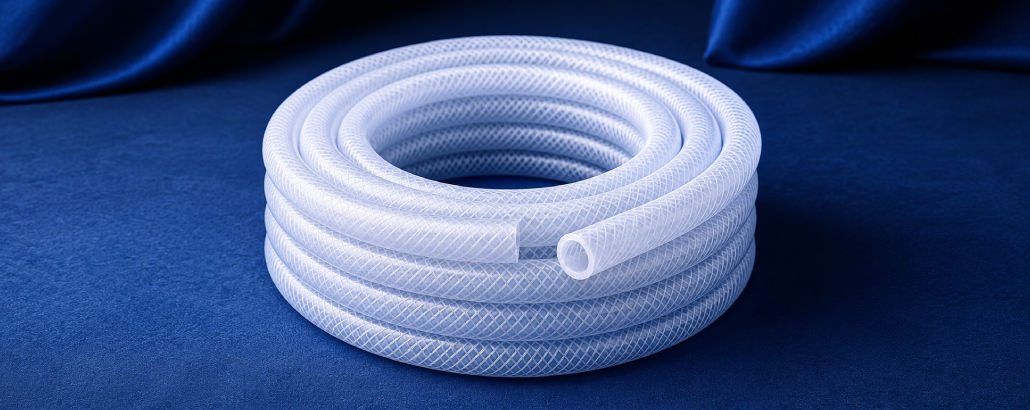
Silicone Braided Hoses Manufacturers in Karnataka and Gujarat
Hydromac Hydraulics manufactures and supplies high-quality Silicone Braided Hoses in Karnataka and Gujarat for industrial applications that require flexibility, temperature resistance, cleanliness, and dependable fluid transfer. Our silicone braided hoses are designed with a durable silicone tube reinforced with braided material, providing improved pressure handling and dimensional stability compared with non-reinforced silicone hoses. These hoses are suitable for industries requiring hygienic and reliable fluid, air, steam, and process-media transfer.
As experienced Silicone Braided Hoses Manufacturers in Karnataka and Gujarat, we focus on consistent manufacturing quality, suitable reinforcement, dimensional accuracy, and application-specific hose construction. Our hoses can be supplied in different sizes, lengths, wall constructions, and connection configurations depending on operating requirements. They are suitable for pharmaceutical, food processing, dairy, chemical, laboratory, medical, cosmetic, and general industrial applications.
Purpose of Silicone Braided Hoses
The primary purpose of Silicone Braided Hoses is to provide a flexible and reliable pathway for transferring fluids, air, gases, and selected process media under demanding operating conditions. Silicone offers flexibility and temperature resistance, while the braided reinforcement helps improve the hose's pressure capability and resistance to deformation.
- Flexible fluid and air transfer
- Reinforced construction for improved pressure handling
- Suitable for temperature-sensitive applications
- Useful for hygienic process environments
- Designed for repeated routing and installation
- Available in application-specific sizes
Key Features of Silicone Braided Hoses
Silicone Braided Hoses combine the flexibility of silicone with the additional mechanical support provided by braided reinforcement. This construction helps the hose maintain its shape during operation while providing better resistance to pressure and mechanical stress than conventional unreinforced silicone tubing.
- High-quality silicone inner tube
- Braided reinforcement
- Flexible and easy to route
- Good temperature resistance
- Smooth internal surface
- Good resistance to aging
Benefits of Silicone Braided Hoses
One of the major advantages of Silicone Braided Hoses is their ability to provide flexibility while maintaining improved structural stability through reinforcement. They can accommodate bends and routing requirements in equipment and process systems, making them practical where rigid piping is difficult to install.
- Flexible installation and routing
- Improved pressure handling compared with non-braided silicone tubing
- Good temperature performance
- Reliable dimensional stability
- Easy handling during installation
- Smooth bore for efficient media flow
Technical Specifications of Silicone Braided Hoses
Hydromac Hydraulics manufactures Silicone Braided Hoses with specifications selected according to the application. Exact pressure, temperature, dimensions, and reinforcement requirements should be finalized based on the conveyed media and operating conditions.
- Tube Material: Silicone rubber
- Reinforcement: Braided textile reinforcement, as required
- Construction: Silicone tube with reinforced braided layer
- Inner Diameter: Available in application-specific sizes
- Outer Diameter: Based on hose construction and selected size
- Length: Standard or customized lengths
- Working Pressure: Application and size dependent
- Temperature Range: Depends on silicone grade and construction
Applications of Silicone Braided Hoses
Hydromac Hydraulics supplies silicone braided hose solutions for a broad range of industrial environments in Karnataka and Gujarat. Selection should always be based on media compatibility, temperature, pressure, cleaning procedures, and applicable industry requirements.
- Pharmaceutical processing equipment
- Food and beverage processing
- Dairy processing systems
- Cosmetic manufacturing
- Chemical processing equipment
- Laboratory equipment
Material Quality of Silicone Braided Hoses
The material quality of a silicone hose directly affects its flexibility, temperature performance, durability, and compatibility with the intended application. Hydromac Hydraulics focuses on suitable silicone material selection and reinforcement construction to produce hoses capable of handling the operational conditions specified by the customer.
- Suitable silicone rubber compound
- Consistent wall thickness
- Appropriate braided reinforcement
- Smooth internal bore
- Good flexibility
- Resistance to environmental aging
Why Choose Hydromac Hydraulics?
Hydromac Hydraulics provides application-oriented hose solutions for industries requiring flexible and reinforced silicone hose assemblies. Our approach focuses on selecting suitable materials, dimensions, reinforcement, and connections according to the customer's operating requirements.
- Application-focused hose solutions
- Quality-oriented silicone material selection
- Reinforced braided construction
- Multiple size and length options
- Customized hose requirements
Frequently Asked Questions
1. What are Silicone Braided Hoses used for?
Silicone Braided Hoses are used for transferring compatible fluids, air, gases, and process media in industries such as pharmaceutical, food processing, dairy, chemical, cosmetic, laboratory, and general industrial applications.
2. What makes braided silicone hoses different from normal silicone hoses?
The main difference is the reinforcement layer. A standard silicone hose may consist primarily of silicone material, whereas a Silicone Braided Hose incorporates braided reinforcement to provide improved pressure handling, dimensional stability, and resistance to deformation while maintaining flexibility.
3. Can Hydromac Hydraulics supply Silicone Braided Hoses in different sizes?
Yes. Hydromac Hydraulics can provide silicone braided hose solutions in different dimensions and lengths based on application requirements. Customers can specify the required internal diameter, operating conditions, hose length, connections, and intended media so that an appropriate configuration can be considered